Solutions
Automation allows us to handle the largest shipping volume in Japan. Newly installed Okura conveyor.
JA Aichi Minami Mom Port Center
overview
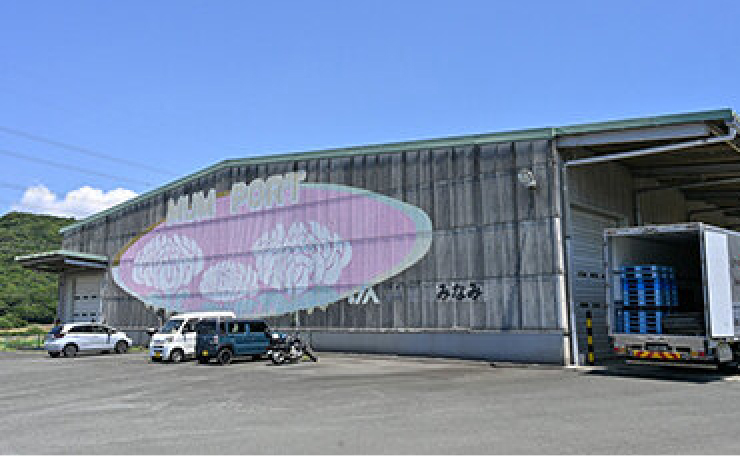
Tahara City, located on the Atsumi Peninsula, is a chrysanthemum-producing region that represents Aichi Prefecture, the flower kingdom. Among these, ring chrysanthemums, which are often used at funerals and Buddhist ceremonies, account for 40% of the domestic market share. Mum Port Center (Tahara City, hereafter MP), operated by JA Aichi Minami, is one of Japan's largest collection and shipping facilities for ring chrysanthemums, and handles the entire process of sorting, packaging, and shipping ring chrysanthemums brought in by producers. In order to establish a more stable shipping system, MP has recently renovated its facilities, including the introduction of Okura conveyors.
Background to the introduction of the equipment
The equipment was recently renewed in conjunction with the removal of five robots that were used to check the number of flowers after selection and pack them into boxes. There were many issues, such as sensor reading problems, so the solution was to switch to manual operation. In conjunction with this, a new Okura conveyor was installed to supply empty boxes to the work area and remove filled boxes, creating a trouble-free shipping system.
Equipment Features
Feature 1
Space-saving with a three-stage line
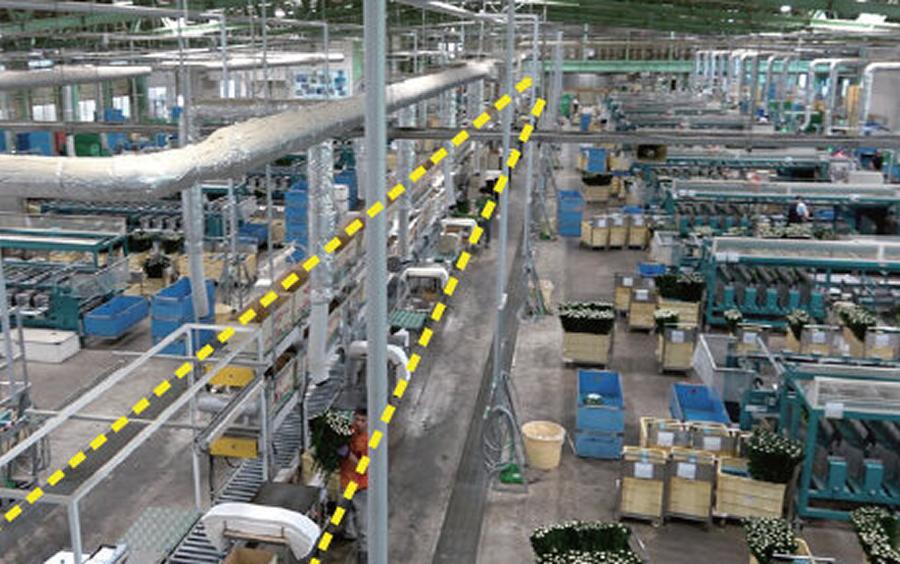
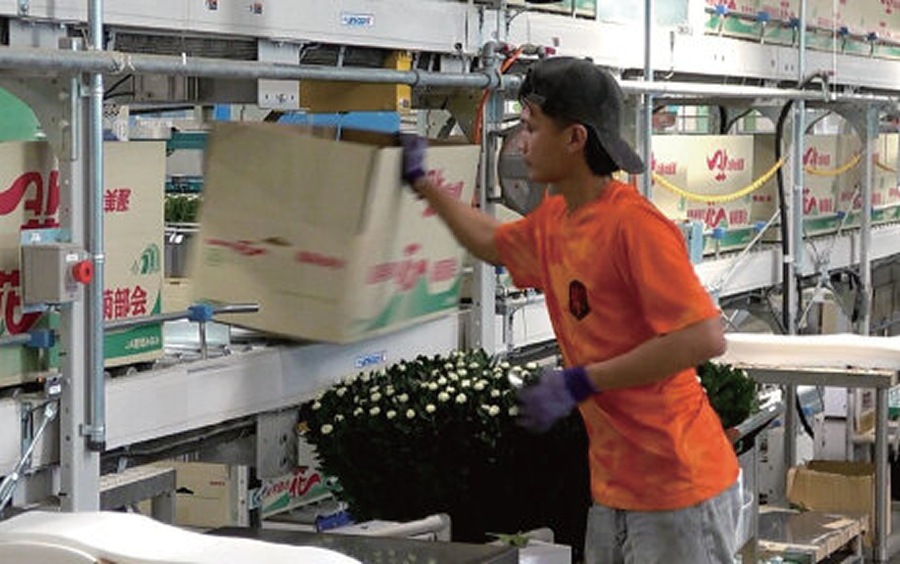
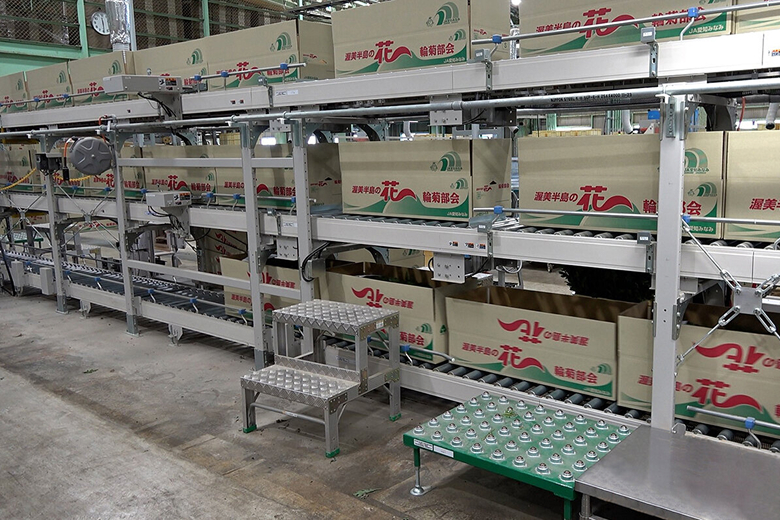
An Okura conveyor line, approximately 60m long and consisting of three levels (1880mm high), was installed in the center of the workshop. A total of 18 flower robots, which serve as the main equipment, are lined up on both sides of the line. They quickly sort each flower chrysanthemum brought in by growers into different grades and automatically bundle the required number of flowers. After the bundles are bundled, workers check the number of flowers and place them into empty cardboard boxes, replacing the unloading and packing robots. Shifting from robotic to manual work required a larger space for the work area and work flow, but this was resolved by reducing the space required by configuring the conveyor line to three levels (the top two levels are for empty boxes and the bottom level is for filled boxes).
A three-tiered conveyor line (enclosed by dashed lines) is installed in the center, with 18 flower robots lined up on either side.
Okura conveyor with a three-tier configuration. The top two tiers are for empty boxes, and the bottom tier is for full boxes.
Feature 2
Easy to remove empty boxes
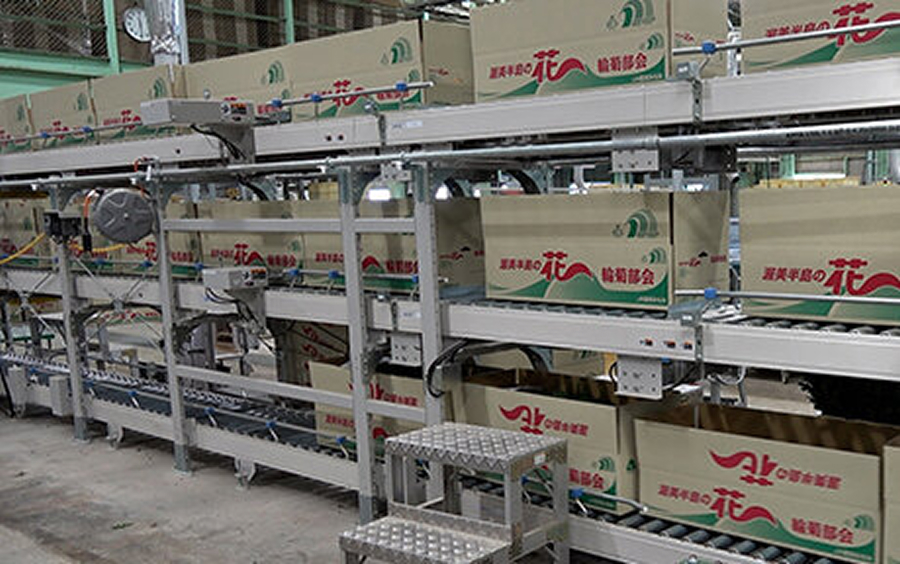
This line uses a Unicon V line drive type, and because empty boxes that are normally tightly packed together due to line pressure are difficult to remove, 18 removal ports installed near each flower robot are freed by stopper control to make removal easy. 160 to 200 daisies are packed into a box, and on the lowest line, they are transported from the automatic packaging machine downstream to the refrigerated automated warehouse to await shipment.
The empty box removal section is free due to stopper control, making it easy to remove.
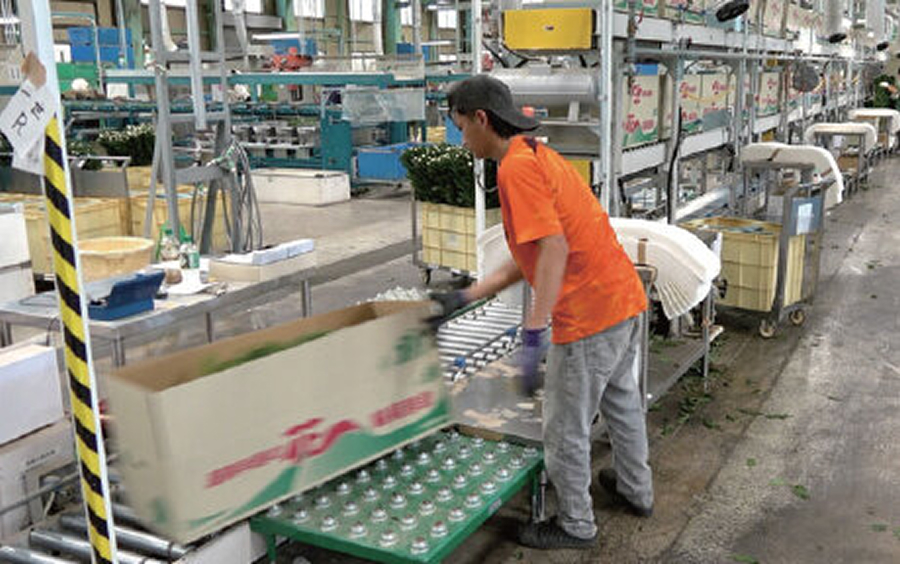
It is put into the lowest line and transported downstream.
Customer testimonials
The role of MP is to reduce the workload associated with shipping for chrysanthemum producers, allowing them to focus on their primary focus of improving quality and expanding scale, and it is currently used by approximately 200 people. This time, we utilized subsidies aimed at building a strong agricultural industry to improve operations, including the introduction of a new conveying line from Okura, with the aim of further improving efficiency and ensuring stable shipping capacity. Thanks to this, the facility continues to operate smoothly. We will fully utilize its functions as Japan's largest shipping facility and support the promotion of local agriculture.
- Company Name
- Aichi Minami Agricultural Cooperative (JA Aichi Minami)
- Business content
- A comprehensive agricultural cooperative based in Tahara City that focuses on agricultural and economic activities.
- Home page
- https://www.ja-aichiminami.jp/
The numerical data and organizational information in the article are current as of the time of the interview.