Solutions

beverage

Seven robot palletizers were installed, enabling mass production and stable supply.

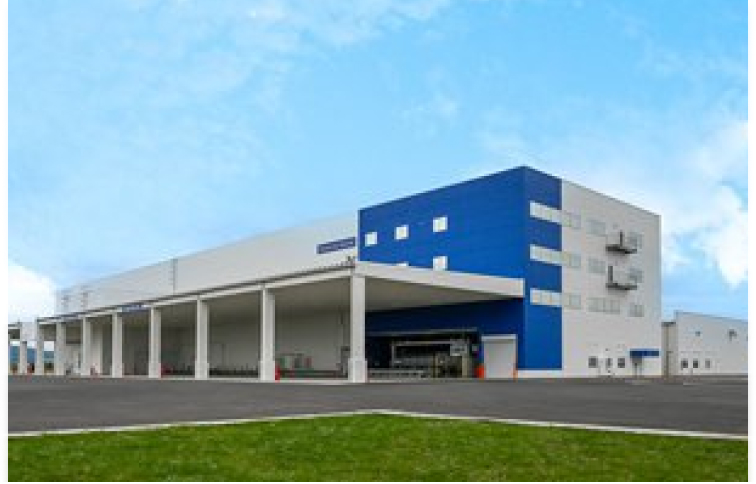
Tomoe Dairy Co., Ltd. 2nd Factory
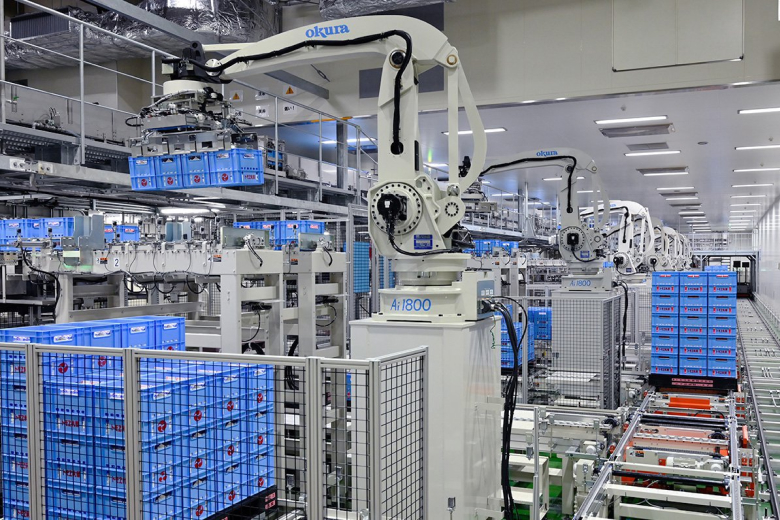
Seven robot palletizers were installed, enabling mass production and stable supply.

overview

Tomoe Dairy Industry, a comprehensive manufacturer of milk and beverages, has a second factory that serves as the production base for its flagship product, milk, as well as the growing coffee and fruit juice beverages. Under strict quality control, the filling product transport line on the first floor is equipped with an Okura conveyor system and seven robot palletizers, achieving thorough labor savings and efficiency. The company has established a system that allows for stable supply to large orders from supermarkets and other businesses.

Equipment Features

Feature 1

Depalletizing collection crates

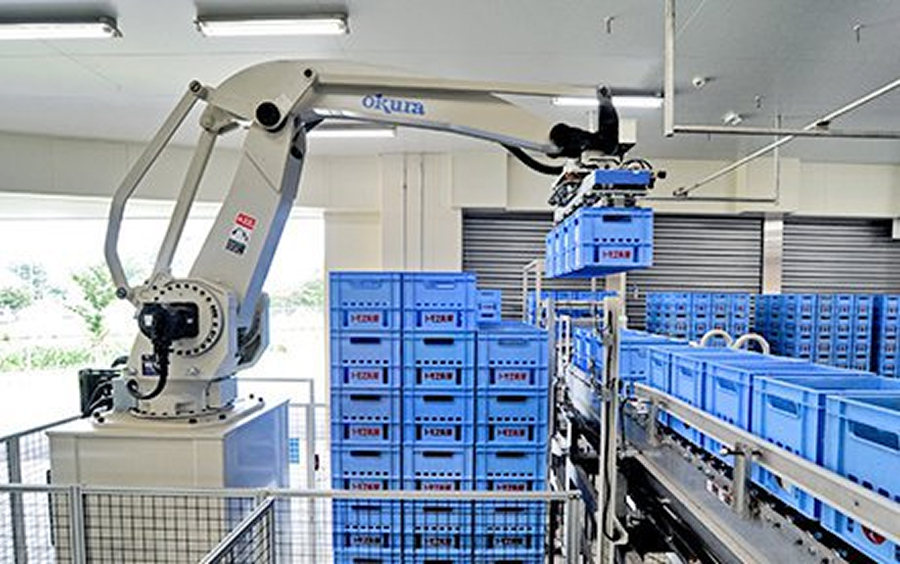
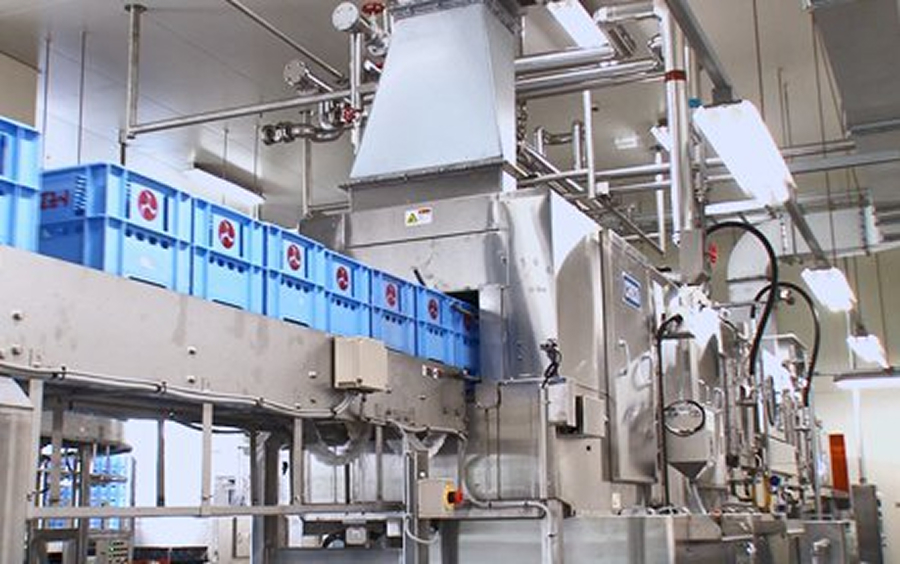
Empty crates collected from retail stores in pallet units are supplied to the washing line. A robotic depalletizer has been installed at the start of the line. It depalletizes the empty crates on the pallets one row at a time (four cases) and transfers them to the washing line. A high-performance, high-speed washing machine has been installed, which thoroughly removes dust, dirt and labels from the crates and even dries them. After washing, the empty crates are transported to the packing area where casers are waiting, and filled paper carton products are packed into them.

A robot depalletizer transfers collected crates to a washing line

A robot depalletizer transfers collected crates to a washing line

The crates are fed into the high-speed washer one after another.

The crates are fed into the high-speed washer one after another.

Feature 2

Palletizing of actual crates

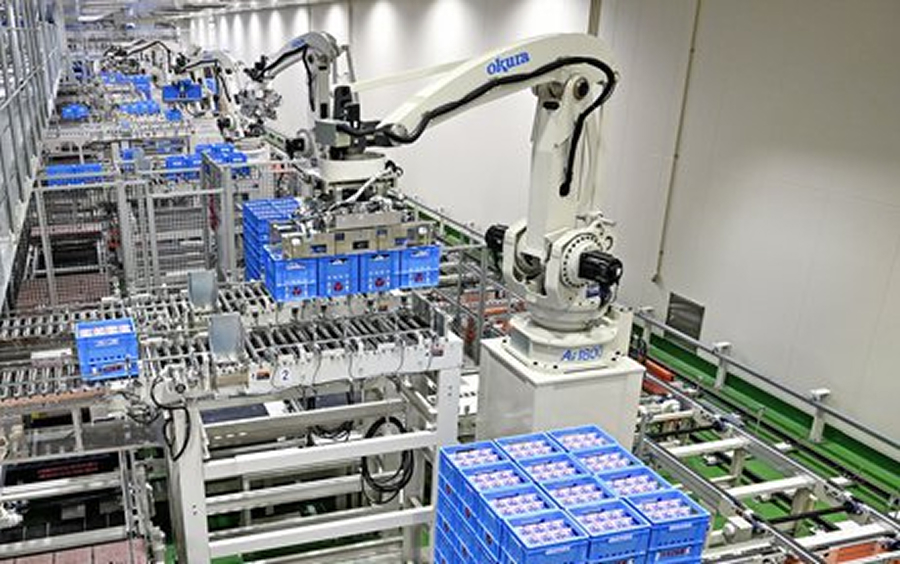
The crates filled with products are transported to the palletizing area, where seven robot palletizers are lined up. Each robot palletizer has two stacking stations, and stacks the products onto two pallets in the order they arrive. The crates have a protrusion called a spigot on the bottom, so if they are not securely fitted into the frame of the crate below, the load will collapse. The robot palletizer achieves reliable stacking by combining a dedicated hand and robot control. Each hand can grab four cases, and accurately stack 12 cases per layer into five layers.

Seven robot palletizers have been installed
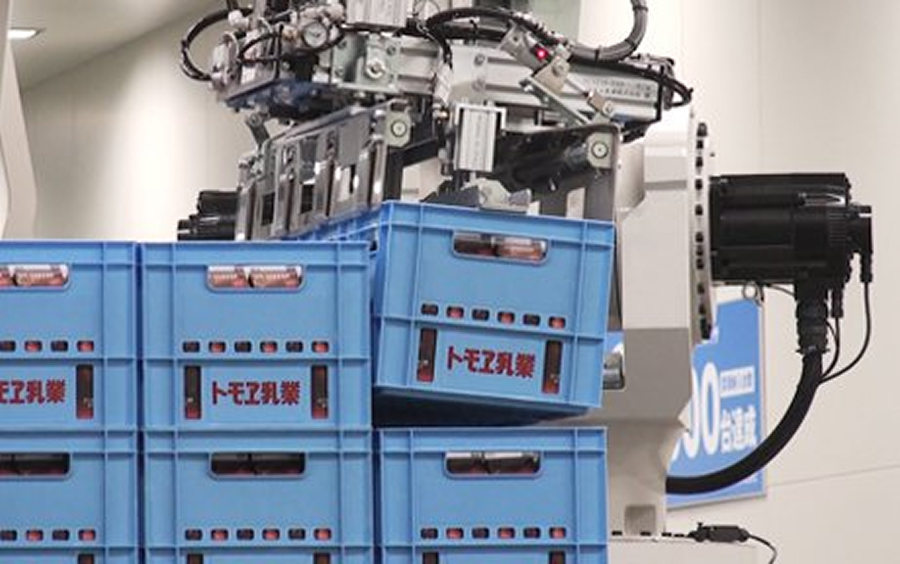
Seven robot palletizers have been installed

The robot palletizer reliably stacks crates with inlays on the bottom.

The robot palletizer reliably stacks crates with inlays on the bottom.

Effects of introducing equipment

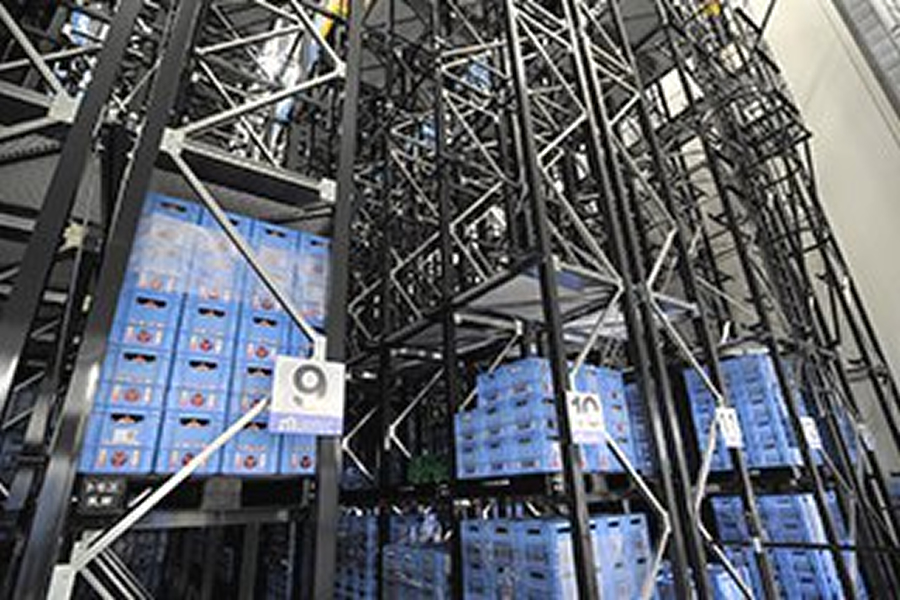
The palletized products are stored in an automated warehouse that can temporarily store 4,600 pallets, and can be shipped at any time. By providing storage functions for the speedy upstream flow, Tomoe Dairy has achieved its goal of stable supply.

An automated warehouse where the temperature inside is kept at 10 degrees

An automated warehouse where the temperature inside is kept at 10 degrees

Customer testimonials

Milk will be produced at the first factory, while the second factory will serve as a production base for coffee drinks and fruit juice drinks, for which demand is expanding. Many customers, such as supermarkets, place large orders for the products manufactured at the second factory, so it was essential to create a system that would allow for a stable supply. To achieve this, it was necessary not only to have a state-of-the-art manufacturing system, but also to build a logistics system that would allow the manufactured products to be shipped efficiently and quickly. By introducing a material handling system that utilizes robots and an automated warehouse for temporary product storage, the company can say that it has now put in place a production system that satisfies customer requests.

Company Name
Tomoe Dairy Co., Ltd.
Business content
Production and sales of milk, dairy products, various beverages, and desserts
Number of employees
343 people (as of April 2021)
Customer testimonials
*The content of this article is based on an interview conducted in January 2023. The numerical data and organizational information in the article are current as of the time of the interview.